
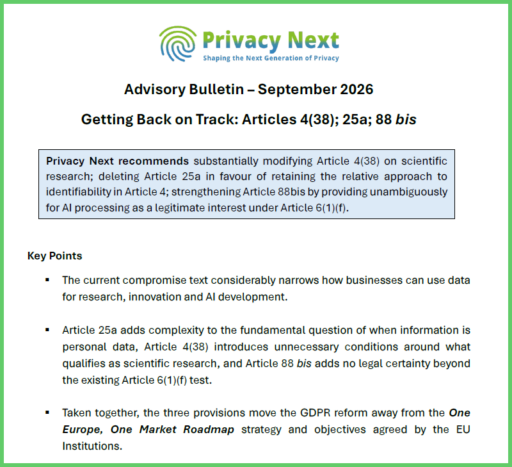
In September, as part of a series of Advisory Bulletins circulated to the Member States and the Presidency, Privacy Next urged the Council to be more ambitious in its approach and to better align its position on the Digital Omnibus with the objectives of the One Europe, One Market, Roadmap.
The Bulletin pointed out that the Council, European Parliament, and Commission had already committed the EU to simplifying rules, accelerating the digital and AI transformation, and strengthening European competitiveness and that the Digital Omnibus should give that strategy practical effect.
Specifically, the Bulletin pointed to three provisions of the Council text on GDPR reform which, taken together, could make the GDPR more restrictive for companies seeking to use data to research, innovate and compete, the opposite of the path promised by the One Europe, One Market Roadmap strategy..
Read the full Advisory Bulletin: Getting Back on Track: Articles 4(38); 25a; 88bis.
In August, 2026, as part of a series of Advisory Bulletins circulated to the Member States and the Presidency, Privacy Next recommended to the Council that the discussions on the Digital Omnibus should reconsider the Commission’s original proposal to amend Article 4, suggesting that it was the more constructive way forward, ensured greater legal certainty and aligned the definition of personal data with legal precedents, using existing personal data boundaries.
Privacy Next concluded by saying that data controllers needed clarity on the most basic GDPR question – does this processing involve personal data? It suggested that introducing a new Article 29a did not answer this question as it added unnecessary complexity, without supporting compliance or protecting fundamental rights. Privacy Next also suggested that discussions on the Article 4 proposals should be reopened to ensure the EU could effectively achieve its agreed data governance objective in an increasingly globalised digital landscape, adding that it believed this approach was not just preferable, but imperative.

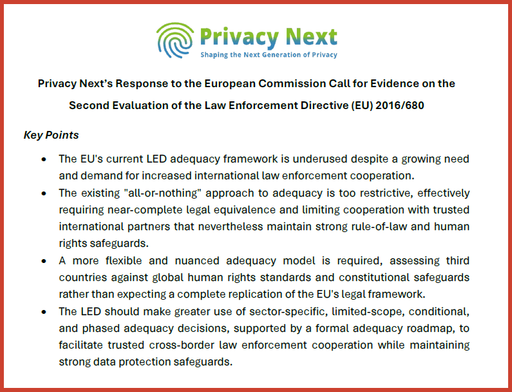
On 14 September 2026, Privacy Next submitted a contribution to the Commission’s second evaluation of the Law Enforcement Directive (LED). This the review offers a timely opportunity to assess whether the legal framework remains fit for purpose amid rapidly evolving transnational criminal activity. Criminal organisations exploit cross-border infrastructures with a speed and sophistication that governments struggle to match and operations are increasingly digital, decentralised and global. Given the context of increasing transnational crime and the increasingly sophisticated use of technology, Privacy Next focuses on the underuse of the LED’s adequacy framework even though there is growing need and demand for increased international law enforcement cooperation.
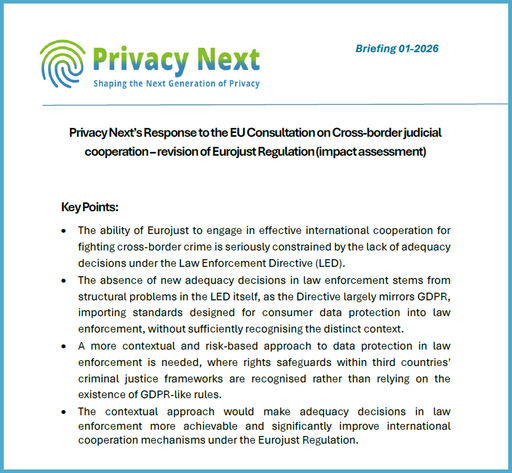
In preparation for a revision of the Eurojust Regulation, the Commission undertook a call for evidence and public consultation to gather a diverse range of views on how the EU can improve Eurojust’s ability to address serious cross-border crime.
The initiative for a revision of the Eurojust Regulation aims to enhance security by increasing Eurojust’s support to national authorities in combating serious and organised crime, which is expected to reduce economic harm, promote stability, and foster growth in the EU. Strengthened efforts against crimes such as drug trafficking, human trafficking, and cybercrime are anticipated to yield social benefits, including improved public safety, health, and online security.
Additionally, the initiative seeks to bolster fundamental rights by ensuring citizen security, improving victims’ access to justice, and safeguarding suspects’ rights. While enhanced information exchange is essential for addressing cross-border crime, the impact on personal data protection must be recognised and appropriate safeguards must be in place.
The revision of the Eurojust Regulation seeks to provide Eurojust with a framework to respond faster and more effectively to organised crime and further enhance the security of society.
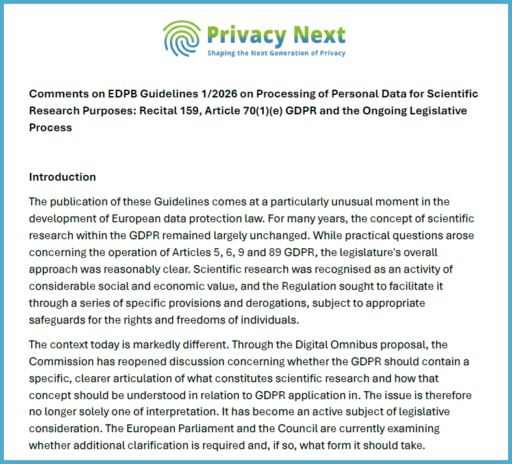
On 16 April 2026, the EDPB adopted Guidelines 1/2026 on the processing of personal data for scientific research purposes and called for feedback on the Guidelines.
There is no question that there is a need for greater clarity on when GDPR applies to scientific research. However, the present Guidelines were developed before the legislative debate surrounding the Digital Omnibus and the future scope of scientific research has reached a conclusion.
In its feedback to the EDPB, Privacy Next asserts that the present Guidelines should be withdrawn and reconsidered once the co-legislators have concluded the Digital Omnibus negotiations. The role of the regulator is to apply agreed laws within an established mandate, not to pre-empt the legislative process.
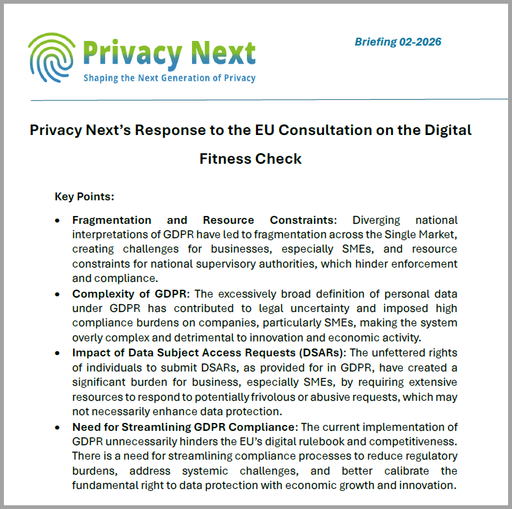
The EU’s Digital Fitness Check is the second stage of the European Commission’s digital simplification agenda, following the targeted regulatory adjustments proposed under the Digital Omnibus. The fitness check was designed as a broad, evidence‑gathering exercise to assess whether the EU’s digital rulebook remains effective, proportionate and fit for the future. The call for evidence and consultation sought the views of stakeholders to examine the cumulative impact of the EU’s digital rules businesses, people, and public authorities, The process had a deliberately tactical focus, inviting stakeholders to share practical experiences with overlaps, inconsistencies and synergies between the rules, and to provide evidence on regulatory burdens and real‑world effects. It is hoped that the consultative process will provide an evidence-based assessment of the EU’s digital rules to determine how well they support EU competitiveness while safeguarding values and fundamental rights.
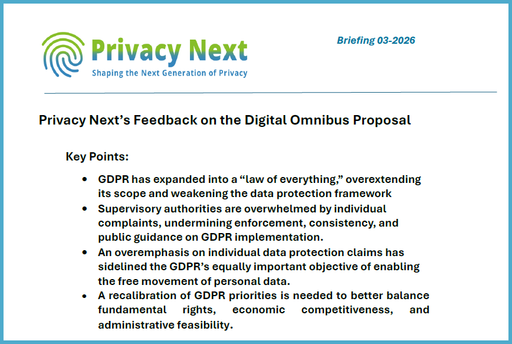
Privacy Next provided a response to the European Commission’s call for feedback on the Digital Omnibus proposal for a regulation – COM(2025)836. The Digital Omnibus proposal comes at a time when the regional organisation and its Member States are pursuing a range of policy priorities – competitiveness, simplification, better enforcement, increased cooperation, and more efficiency are all identified as necessary matters to address. Privacy Next is of the view that these are not mutually exclusive choices in the process of legislative reform. The data governance framework has been built recognising the need to adapt to the technical and social developments in society while maintaining sufficient safeguards for the protection of personal data. Both objectives must be pursued to ensure the effective functioning of the EU’s Single/internal market.
The feedback submitted by Privacy Next raised the following key points:
Square de Meeûs 18
1050 Brussels | Belgium
info@privacynext.eu

Copyrights © 2026 PrivacyNext.eu | Privacy Policy | Cookie Policy Webdesign & Development by ALYS