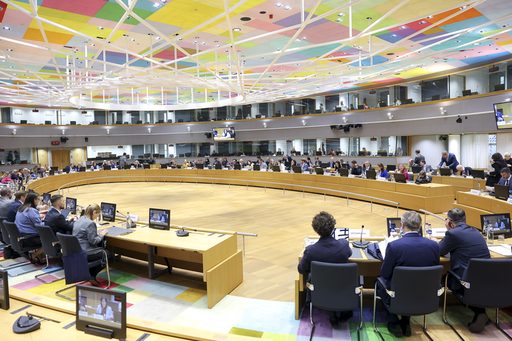
At their meeting on 21/10/2026, EU Ambassadors (COREPER II) agreed the Council negotiating position on the Digital Omnibus by a qualified majority.
The approved compromise text will now form the Council’s negotiating position for the trilogue discussions with the European Parliament and the Commission, forecast to commence in Q1 or Q2, 2027, once the Parliament has also adopted its negotiating position.
As previously highlighted here by Privacy Next, the approved compromise text is a significantly watered-down version of the original Commission proposal and is difficult to reconcile with the ambition for EU competitiveness already agreed by all the EU Institutions in the One Europe, One Market, Roadmap, despite claims to the contrary in the press release announcing today’s approval by EU Ambassadors. The lack of alignment with that high-level EU roadmap is strikingly evident from the Council’s approach to innovation-critical personal data processing under GDPR, including for AI development/deployment, scientific research and outsourced data processing, with the Council opting for a complex suite of additional rules instead of the regulatory simplification that was promised.
21 October, 2026

What is the Council trying to achieve by making it harder for businesses to outsource data processing in ways that enhance privacy?
In the Digital Omnibus negotiations, Germany and Sweden, with Denmark’s support, have proposed that processors should remain subject to GDPR even where they cannot realistically identify the individuals whose data they process. The apparent lack of opposition in Council suggests the proposal may enjoy wider support.
But what is the rationale?
Businesses increasingly outsource data analytics and AI development to specialist providers, removing identifying information and minimising the processing of personal data in the process. These arrangements reduce costs, improve efficiency, and provide better protection for individuals.
Why would policymakers want to discourage this? What economic or privacy benefit would justify doing so? How does this support the free movement of personal data in the EU?
The proposal could even encourage businesses to use independent third parties rather than processors, potentially weakening accountability.
The EU’s 𝘖𝘯𝘦 𝘌𝘶𝘳𝘰𝘱𝘦, 𝘖𝘯𝘦 𝘔𝘢𝘳𝘬𝘦𝘵 𝘙𝘰𝘢𝘥𝘮𝘢𝘱 promises simplification, innovation and competitiveness. It is difficult to see how this proposal advances those objectives.
Europe cannot credibly promise to simplify regulation and strengthen competitiveness while introducing rules that may penalise businesses for reducing privacy risks. If the objective is to protect personal data, policymakers must explain why regulation for the sake of regulation should take precedence over encouraging processing arrangements that deliver better privacy outcomes.
19 October, 2026
On 12-13 October, Privacy Next attended the 2026 Confederation of European Data Protection Organisations (CEDPO) DPO Conference in Brussels. The conference theme was “Is Simplicity the Key? Assessing the EU Digital Omnibus and the Future of GDPR.” The event brought together a diverse range of voices including policymakers, regulators, DPOs, industry representatives, and other privacy experts.

The overall message from CEDPO 2026 was not that GDPR should be weakened, but that Europe must improve the practical operation of its digital regulatory framework. Further, the event made clear that the DPO role increasingly sits at the intersection of privacy, AI, cybersecurity, data governance, and innovation strategy. As the future of data protection in the EU continues to be debated, the conference made clear that regulatory coherence across legislation is necessary to support how organisations operate and that a risk-based governance approach is needed for GDPR implementation.
One of the strongest themes throughout the conference was the continuing evolution of the Data Protection Officer role. Speakers highlighted how the ever-growing data-based economy is creating a transition for DPOs from compliance specialists to broader governance professionals. In many organisations, DPOs are now not limited to navigating the GDPR, with responsibilities extending to AI regulation, data governance frameworks, and other emerging digital rules. This makes clear that data protection is no longer a standalone legal function but an essential component of corporate strategy and innovation governance.
The ongoing discussions over the Digital Omnibus were a major part of the event. Several speakers expressed the need to address areas where data protection regulation has generated excessive complexity, legal uncertainty, and unnecessary costs. At the same time, the high levels of data protection the EU has achieved must be maintained. To achieve this, it is imperative to reform the GDPR so it works more effectively in practice while preserving legal certainty. For addressing legal certainty, attention was given to the matter of divergent interpretation by regulators across the Member States, hindering the free flow of data, a stated objective of the GDPR.

Inconsistent implementation and divergent interpretations are most apparent in relation to the definition of personal data. Multiple speakers argued that the definition has become subject to increasingly broad interpretation, creating a variety of obstacles for organisations. Further attention was given to the means by which regulators appear to be overly reliant on consent as a lawful basis for processing data when there are multiple legal bases that can be used. Legitimate flexibility should be possible but remains an underused principle in practice. This is especially clear in scientific research, where speakers highlighted persistent uncertainty about the scope and application of the GDPR’s research provisions. Participants argued that clearer definitions and more consistent application are necessary to support innovation, particularly in health research and data-intensive scientific projects.
AI governance was also a prominent topic during the conference. Discussions recognised that organisations face growing challenges in operationalising AI governance against a backdrop of overlapping regulatory requirements, including data protection. It was expressed that effective AI governance requires clear accountability structures, transparency regarding authorised AI use, and appropriate oversight mechanisms. Going forward, as AI governance and data governance converge into a single policy conversation, frameworks need to balance rights protection with competitiveness, innovation, and the technological advancements being delivered by AI.
For Privacy Next, the conference underscored the growing policy consensus that effective data governance must move beyond compliance and become an enabler of business innovation, with DPOs playing a key role in responsible data use. Attention needs to continue to focus on furthering regulatory coherence, legal certainty, and creating conditions that allow organisations to generate value from data while preserving trust and accountability.
19 October, 2026

The Permanent Representatives Committee, otherwise known as COREPER II, will discuss the Digital Omnibus, on 21/10/2026, after earlier deferred attempts on 07/10/2026 and 11/10/2026, following an objection from Germany on a provision of the Data Act.
It is likely that the Council position on the proposal will be formally approved by EU Ambassadors, unless further objections are raised by Member States before or during the meeting.
Privacy Next has previously expressed disappointment at the Council position on many of the proposed GDPR reforms included in the Digital Omnibus package, particularly on identifiability, scientific research and AI processing. See our assessment here.
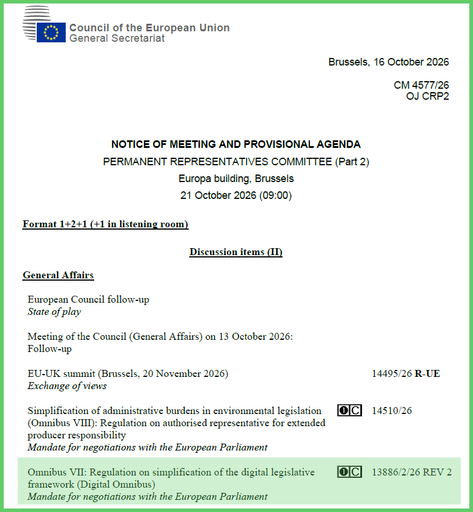
19 October, 2026.
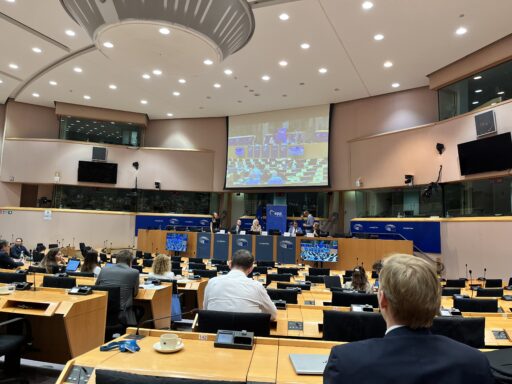
On 1 July, Privacy Next attended a Group Hearing on the Digital Omnibus, under the title “Simplifying European Digital Rules”. The Hearing was hosted by the European People’s Party (EPP).
The hearing addressed key issues around data consolidation, cybersecurity, and modernising privacy for the AI era. Discussion revealed that the debate is ultimately about how the EU defines and governs personal data in a data-driven economy. Speakers argued that the Commission’s simplification agenda will succeed only if it addresses legal uncertainty surrounding personal, pseudonymised, and non-personal data.
A recurring theme was that the current interpretation of personal data extends GDPR obligations beyond situations where individuals face meaningful privacy risks. It was discussed that pseudonymisation should be recognised as a stronger technical safeguard rather than as merely different from identifiable data. If organisations implement robust technical controls and retain identifying keys separately, in line with the CJEU’s judgment in the SRB case, organisations and regulators could focus on the protections in place rather than on extensive contractual arrangements in the data ecosystem.
Scientific research and AI were central, with health and medtech stakeholders noting that uncertainty around data identifiability and legal bases often delays collaborations. Speakers argued that clearer recognition of pseudonymised data and more enabling rules for health data use could reduce friction, support AI development, and strengthen European competitiveness while maintaining robust privacy protections.

We are pleased to announce that we have moved into new bespoke offices at Square de Meeûs 18, in the heart of the European Quarter, marking a significant investment in our Brussels presence and giving ample room for expansion in the years ahead.

Most importantly, our new home, complete with a spectacular private terrace, gives us a great space to welcome clients, partners, policymakers and friends. If you are passing through the European Quarter, our door is open. A hearty welcome and refreshments are guaranteed, alongside plenty of conversation about shaping the next generation of privacy.

It is a fitting location for the next stage of Privacy Next’s development, with spectacular views across the European Parliament and towards the Council of the European Union beyond — keeping the institutions shaping Europe’s privacy landscape firmly in sight.

We look forward to welcoming many of you to Square de Meeûs as Privacy Next begins this next chapter in Brussels.

On 06/10/2026, Privacy Next was pleased to address an informal gathering of Justice & Home Affairs diplomats from various non-EU Missions, kindly hosted by Scotland and organised by Northern Ireland. Other Missions represented included the UK, Canada, Japan and Switzerland.
The general topic for discussion was data protection in the EU and developments affecting third countries, particularly in relation to cross-border police and judicial cooperation.
One of the specific topics discussed was the current review of the 2016 Law Enforcement Directive and the anticipated call for greater cooperation with third countries in the fight against cross-border organised crime and terrorism.
The audience heard Privacy Next encourage all non-EU countries to strengthen their law enforcement and judicial cooperation channels with the EU, through the use of data adequacy assessments/decisions, Passenger Name Record (PNR) agreements and bilateral data sharing agreements, to ensure that operational needs and the protection of personal data are fully optimised in pursuing such important objectives.
On 4 September, Privacy Next attended the Centre for European Policy Studies (CEPS) event for the launch of the CEPS Task Force report, Next Steps for EU law and Regulation for the Digital World.
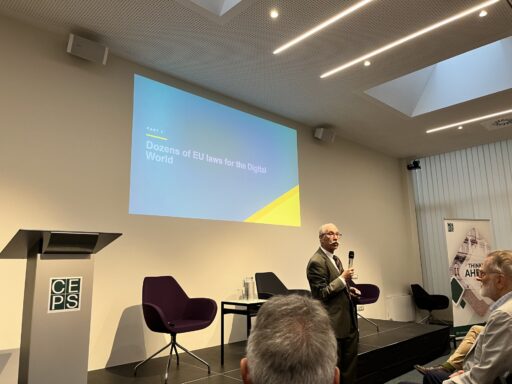
This project examined how the EU’s rapidly expanding digital regulatory framework can be streamlined and improved. Regarding data protection, the report argues that the GDPR gives insufficient practical effect to the EU principle of proportionality and fails to adequately balance data protection against other legitimate interests, including innovation, research, public health, competitiveness, and other fundamental rights. Although a GRPR recital acknowledges proportionality, there is no operative mechanism to implement it. As a result, courts and the EDPB have focused almost exclusively on privacy protection, marginalising other EU objectives and interests.
Further, the report suggests the EDPB’s current decision-making process lacks sufficient accountability and consideration of proportionality. It notes that EDPB decisions are difficult for affected parties to challenge directly and that there is no meaningful appeal route. The report calls for reforms that should introduce stronger accountability and judicial review mechanisms for the EDPB.
The report also highlights growing tensions and inconsistencies between the GDPR and newer EU laws such as the Digital Markets Act, Data Act, European Health Data Space, and cybersecurity legislation. It calls for future reforms that better reconcile overlapping policy objectives and reduce regulatory complexity.

The European Parliament’s work on the Digital Omnibus continued during September in the joint committee (ITRE/LIBE). The focus is on the report of the co-rapporteurs and the amendments tabled by individual MEPs. The co-rapporteurs are working with the political groups’ shadow rapporteurs to organise the amendments and establish the varying political positions.
Once the amendments are organised by article or issue, technical and political discussions will follow and then compromise amendments will emerge. Where compromise cannot be achieved, the amendments may be voted on individually in committee. However, depending on how the Council finalises its negotiating position, this could influence the political trade-offs in the joint committee.
This work will continue through the remainder of 2026. The hope is that the joint committee report can be agreed in early 2027, but this is looking optimistic given the divergent positions that exist and an MEP close to the discussions only this week suggested that it could be as late as Q2, 2027. As the co-rapporteurs were unable to agree on key issues such as the definition of personal data, legitimate interest for AI training, and how to treat the definition of scientific research, compromise still appears distant. The various further amendments tabled also show opposing positions between the political groups on these matters, along with varying views being expressed within the political groups. Representatives from interest groups continue to meet with the rapporteurs and other committee members to express views on the Digital Omnibus.
Privacy Next will continue to follow developments closely.
15 October, 2026
The Council of the EU is close to finalising its negotiating position on the Digital Omnibus, following further discussions under the Irish Presidency. Two revised compromise texts were circulated ahead of meetings of the Antici Group (Simplification) on 11 and 25 September 2026, bringing months of negotiations between Member States towards a conclusion.
The latest compromise was scheduled for endorsement by the Permanent Representatives Committee (COREPER II) on 7 October, but consideration was deferred following objections led by Germany concerning trade secrets protection under the Data Act. A further attempt to secure agreement on 11 October was subsequently postponed, with no new date yet confirmed. Although the outstanding dispute does not directly concern the GDPR provisions, it has delayed formal agreement on the Council’s negotiating mandate.
For Privacy Next, the emerging Council position represents a disappointing outcome. While successive compromise texts have delivered some improvements, the negotiations have failed to match the ambition of the Commission’s original proposals or the EU’s wider commitments to simplification, innovation and competitiveness.
The evolution of the provisions on the definition of personal data illustrates the problem. What began as an attempt to provide greater legal certainty by clarifying when individuals are realistically identifiable has evolved into an increasingly complex set of qualifications designed to preserve the GDPR’s regulatory reach. Opportunities to facilitate scientific research and provide greater certainty for AI development have also been weakened.
More fundamentally, the negotiations reveal an imbalance in the Council’s approach. Considerable attention has been devoted to preserving existing regulatory protections, with insufficient weight given to the equally important objectives of legal certainty, innovation and the free movement of personal data.
This is difficult to reconcile with the commitments made in the One Market, One Europe Roadmap, endorsed at the highest EU political level, to strengthen Europe’s competitiveness, simplify regulation and support innovation. The Council’s emerging position on the Digital Omnibus falls short of translating those commitments into meaningful legislative reform.
With the Council’s position substantially settled, attention now turns to the European Parliament, where the joint LIBE/ITRE Committee is examining amendments to the Commission proposal.
Privacy Next believes Parliament has an important opportunity to restore ambition to the Digital Omnibus and ensure that the EU’s wider economic and strategic objectives are properly reflected in GDPR reform.
Strong data protection, legal certainty and innovation should not be treated as competing objectives. Achieving all three must remain the ambition for the next generation of privacy.
15 October, 2026

Council negotiations on the GDPR elements of the Digital Omnibus resume in September, with the first new compromise text of the Irish Presidency expected shortly.
Before the summer break, the Presidency used the Antici Group (Simplification) meeting on 16 July to take a fresh look at some of the key outstanding issues. Its discussion paper expressly recognised calls from some Member States to increase the level of ambition of the GDPR reforms and deliver more concrete simplification benefits for businesses, while maintaining an appropriate level of protection. Importantly, the Presidency asked whether the existing Council approach was actually providing the legal certainty that organisations need.
That question was particularly explicit in relation to the scope of personal data. The Cyprus Presidency had moved away from the Commission’s proposal to clarify the definition of personal data itself, instead developing a new Article 29a dealing with pseudonymisation and identifiability. In July, Ireland invited Member States to reconsider whether that approach delivers meaningful simplification and legal certainty.
The same is true for AI. The June compromise removed the Commission’s proposed operative provision on processing personal data in the development and operation of AI and replaced it principally with a recital stating that such processing may, in appropriate cases, constitute a legitimate interest under Article 6(1)(f). The Irish Presidency specifically asked Member States whether this provides sufficient legal certainty and invited proposals for further measures to facilitate compliance for organisations developing and operating AI systems.
Privacy Next understands that Member States were subsequently invited to submit additional written comments and that a new compromise text is expected to be circulated during the first week of September, ahead of the next Antici Group discussion scheduled for 11 September. The Council calendar confirms a further Antici Group meeting on that date.
The new text will therefore be an important indication of how the Presidency intends to bridge the remaining differences. Alongside personal data and AI, compromises are still needed on scientific research, where the June text introduced a considerably more prescriptive definition and conditions around matters including transparency, verifiability and research independence, and on abusive data subject requests, where the Council has continued to refine when controllers should be able to refuse or charge for excessive or abusive requests.
For Privacy Next, the test remains whether the eventual Council position delivers genuine reform: clearer rules on when the GDPR applies, a workable legal framework for AI and scientific research, and proportionate tools for organisations dealing with misuse of data protection rights. September may tell us whether the Council is moving closer to finding that balance.
Privacy Next will continue to follow the negotiations closely and advocate for reforms that protect personal data while giving European businesses greater legal certainty and the space to innovate and compete.
01 September, 2026
The Council negotiations on the GDPR elements of the Digital Omnibus have entered a new phase following the end of the Cyprus Presidency on 30 June.
In the final days of June, the Cyprus Presidency withdrew its compromise text from the COREPER II approval process after it became clear that the text did not command the support of a qualified majority of Member States. The Council therefore did not succeed in settling its position before the Presidency passed to Ireland on 1 July.
That leaves the file at an important juncture. The Council has made significant progress in recent months, but it has not yet found a position capable of securing Member State support while also delivering on the stated purpose of the Omnibus: simplification, legal certainty and support for Europe’s competitiveness agenda.
That matters because the Council text has moved some distance away from the European Commission’s original proposal. Several of the Commission’s more practical simplification measures have been weakened, removed or redirected towards future guidance rather than being resolved in the legislative text itself. The risk is that the Council ends up producing a more cautious compromise without solving the underlying problem of legal uncertainty for the organisations that have to apply the GDPR in practice.
As the Irish Presidency takes over, many stakeholders would like to see the Council use this moment to re-focus on the original purpose of the reform. The Digital Omnibus, building upon the findings of the Draghi Report, seeks to support, rather than constrain, innovation leading to increased economic growth. That requires revisiting the simplification proposals in the round and asking whether the emerging Council position genuinely makes the GDPR easier to apply in a proportionate, predictable and innovation-friendly way. In particular, the emerging text should continue to support clearer legislative solutions on issues such as the definition of personal data, abusive access requests, more proportionate breach notification rules, and a more workable framework for innovation, AI and scientific research.
The next phase of negotiations should also involve meaningful engagement with the businesses and other stakeholders who are expected to deliver Europe’s competitiveness agenda in practice. If the Digital Omnibus is intended to reduce unnecessary burden and create a more modern data protection framework, then the operational experience of those applying the rules every day needs to be central to the debate.
Privacy Next will continue to follow the file closely under the Irish Presidency and will be advocating for a final Council position that better balances privacy, legal certainty and competitiveness. The current pause in the negotiations gives the Council an opportunity to revisit the file and get that balance right.
08 July, 2026

Discussions on the GDPR elements of the Digital Omnibus proposal continue within the Council of the European Union as the Cyprus Presidency seeks to make progress before the end of its term on 30 June 2026.
The most recent technical discussion took place at the Antici Group (Simplification) on 27 May 2026. That meeting was based on a Presidency compromise text circulated on 21 May and provided Member States with a further opportunity to comment on the direction of the proposed GDPR reforms. Delegations were subsequently invited to provide additional written observations to the Presidency.
The discussions are taking place against the backdrop of significant differences between the European Commission’s original proposal of November 2025 and the approach reflected in the Presidency’s compromise text. While negotiations continue, a revised Presidency compromise text dealing specifically with the GDPR provisions has not yet been circulated.
The file has also moved beyond purely technical discussions. Privacy Next understands that certain elements of the proposal were referred to COREPER on 8 June 2026 for political guidance. This suggests that the Presidency sought direction from Member States on some of the more sensitive policy questions before presenting a further compromise text on 10 June 2026.
Attention will now focus on the next meeting of the Antici Group (Simplification), scheduled for 15 June 2026. That meeting may provide a clearer indication of whether sufficient political convergence exists to allow the Presidency to move towards a common Council position.
The timing is significant. With less than three weeks remaining before the end of the Cyprus Presidency, pressure is increasing to narrow outstanding differences and establish a clearer negotiating position. At the same time, the referral for political guidance suggests that a number of important issues remain unresolved.
The coming weeks are therefore likely to be decisive in determining both the scope of the eventual Council position and the extent to which the Commission’s original vision for GDPR simplification survives the Council negotiations.
Privacy Next will continue to monitor developments closely and provide further updates as negotiations progress.
10 June, 2026
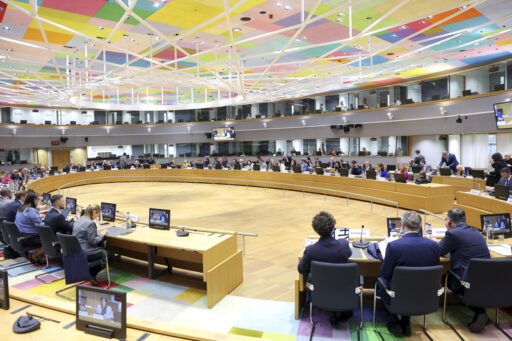
Following the meeting of the Antici Group (Simplification) on 24 April 2026, discussions within the Council on the GDPR related elements of the Digital Omnibus, under inter institutional file 2025/0360, appear to be entering a more decisive phase. While no formal public agenda has yet been released identifying the precise timing of the next exchange on the GDPR amendments, attention within Brussels is increasingly turning towards the final weeks of the current Presidency’s handling of the file.
At present, there is no publicly available confirmation of the next dedicated discussion on the GDPR amendments within the Antici Group (Simplification). It appears that the next substantive meeting will likely take place during the last week of May. The next meeting of the Antici Group (Simplification) is increasingly being viewed as an important staging point for the Presidency’s efforts to consolidate Member State positions before the end of its term on 30 June 2026.
The anticipated discussions are expected to focus on a further revised compromise text being developed by the Presidency following the written comments and exchanges held since February. In particular, the Presidency now appears to be moving away from broader conceptual amendments and towards a narrower package of changes capable of attracting sufficient consensus among delegations.
Among the issues expected to feature prominently are the treatment of the proposed clarifications concerning personal data and entity specific identifiability, the future role of implementing acts versus EDPB guidance mechanisms, and procedural simplification measures relating to documentation obligations, DPIAs, and personal data breach notifications. While these remain framed as technical amendments, they increasingly touch upon wider institutional questions concerning legal certainty, supervisory discretion, and the overall balance of the GDPR framework.
There are also indications that the Presidency may now be prioritising deliverability over ambition. Several Member States continue to support targeted burden reduction measures, particularly for smaller organisations and lower risk processing operations. At the same time, resistance appears to remain around any drafting changes capable of being interpreted as reopening more fundamental debates on accountability, lawful processing, or the definition of personal data itself.
Against this backdrop, the next Antici Group (Simplification) meeting may prove particularly significant. Beyond the substance of individual amendments, it is increasingly expected to test whether the Presidency believes sufficient convergence now exists to begin moving towards a more stable final compromise text.
Indeed, there are growing indications within Brussels that the Cyprus Presidency may be seeking to finalise a consolidated compromise position before the end of its term on 30 June 2026. If accurate, this would significantly increase the political importance of the remaining May and June discussions. The coming weeks may therefore determine not only the scope of the final simplification package, but also whether the Council can maintain momentum behind targeted GDPR reform without triggering wider political resistance from more cautious delegations.
For stakeholders monitoring the file, the current phase is therefore likely to be one of the most important since the proposal was first introduced. Much of the real negotiation now appears to be taking place through quieter drafting and bilateral calibration behind the scenes, with the next Antici Group (Simplification) discussions expected to provide the clearest indication yet of where the Council’s eventual landing zone may emerge.
18 May, 2026
On 19 March, 2026, Commissioner Magnus Brunner appeared before the European Parliament’s LIBE Committee to discuss revising Europol’s mandate to address persistent gaps in cooperation and information-sharing.
The concern; Europe’s fragmented law enforcement framework is becoming a structural vulnerability, one that organised crime is increasingly exploiting.
The meeting highlighted the increasing sophistication of organised crime, particularly as criminal operations utilise digital technologies that transcend jurisdictional borders.
A key takeaway from the discussion was the urgent need for improved information exchange among EU Member States and between EU agencies like Europol, Eurojust, and EPPO. Currently, fragmented rules hamper cooperation, ultimately affecting security within the European Union. Closing the information gap is imperative for effective law enforcement and investigations into cross-border crimes.
Moreover, the importance of fostering international partnerships cannot be overstated. As emphasised by the Council of the European Union in the review of the Law Enforcement Directive, strengthening cooperation with third countries and international organisations is essential to combatting global crime effectively.
The proposed new Europol Regulation is due to be published in Q2 2026. The proposals for improving Europol’s operational effectiveness need to ensure security measures are undertaken while protecting citizens’ rights and civil liberties. Solid regulatory frameworks can empower Europol while ensuring respect for fundamental rights within criminal justice systems.
As ever, Privacy Next will be following developments and providing updates.
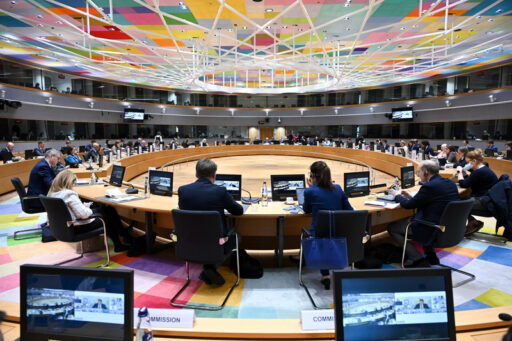
Discussions within the Council of the European Union on the GDPR-related elements of the Digital Omnibus have entered a quieter phase following the last exchange at the Antici Group (Simplification) on 27 February 2026. That meeting marked the first structured opportunity for Member States to react to the Presidency text on the Commission’s proposed adjustments to the General Data Protection Regulation (GDPR). Since then, the file has not returned to the agenda of the Antici Group (Simplification).
This pause is notable not because the Antici Group (Simplification) has been inactive—it continues to meet regularly on other Omnibus files—but because of the absence of any follow-up specifically on GDPR-related changes.
One key explanation lies in the decision, following the February meeting, to invite Member States to submit written comments on the proposed GDPR amendments by 18 March, 2026. This effectively positioned March as a period of written consultation rather than in-person negotiation. For a file of this sensitivity, such an approach is understandable. GDPR remains a cornerstone of the EU’s regulatory framework, and even targeted “simplification” measures can have wider implications for enforcement, accountability, and legal certainty. Written submissions allow delegations to articulate more carefully calibrated positions, including internal red lines, without the immediacy of negotiations.
At the same time, the reliance on written comments suggests that underlying divergences may be more pronounced than initially anticipated. While some Member States are likely supportive of reducing administrative burdens and clarifying obligations, particularly for smaller organisations, others remain cautious about any changes that could weaken established accountability mechanisms or introduce interpretative ambiguity. These tensions are not easily resolved and may explain why the Presidency has not yet reconvened the Antici Group (Simplification) to advance discussions.
The period since the deadline for written comments is therefore particularly telling. The absence of a prompt return to formal technical discussions may indicate that the written feedback revealed a broad spectrum of views, requiring further bilateral engagement before a collective exchange can be productive. In this sense, the current lull appears less a pause in substance than a phase of quieter political calibration behind the scenes.
Nonetheless, the gap carries implications. Procedurally, it reduces visibility for stakeholders attempting to track the Council’s position. Substantively, it risks slowing momentum on what were presented as targeted and technical adjustments. The longer discussions remain outside a structured forum, the greater the risk that positions harden rather than converge.
Looking ahead, there are early indications of when discussions may resume. Privacy Next understands, based on local sources, that the next meeting of the Antici Group (Simplification) could take place in late April, with 24 or 27 April mentioned as possible dates. If confirmed, this would provide the first opportunity to test how far Member States have moved following the written consultation phase and whether a path toward compromise is emerging.
Until then, the extended gap since 27 February stands out. While partly explained by the shift to written input, it also underscores the political sensitivity of even limited changes to GDPR, and the challenges the Council faces in translating a simplification agenda into concrete progress.
06 April, 2026

This year is set to be pivotal for the EU’s agenda on law enforcement cooperation and data privacy. There are numerous reviews of existing legislation, and potentially new legislative proposals, on law enforcement cooperation and data flows.
The second review report on the Law Enforcement Directive is due 6 May 2026. The evaluation report and possible legislative proposal for the Europol Regulation is expected before July, 2026. The Commission is also preparing a legislative proposal for a revised Eurojust Regulation later in 2026. Also, before the end of 2026, the Commission is expected to deliver a new proposal extending the Prüm II Framework to selected non-EU Member States.
Expanding cooperation in law enforcement generally, and in the sharing of data, is a key part of the EU’s political and strategic agenda for supporting a “Strong and Secure Europe.” Action in this area is driven by the need to address increasingly transnational, digital, and organised crime, which requires cooperation both within the EU and with other partner states.
During its February meetings, the European Parliament Committee on Civil Liberties, Justice and Home Affairs (LIBE) addressed a number of legislative proposals related to personal data and law enforcement cooperation.
The Committee approved the draft Agreement between the European Union and the Republic of Ecuador on cooperation between Europol and the Ecuadorian authorities competent to combat serious crime and terrorism. Cooperation between Europol and Ecuador already exists through a working arrangement agreed in October 2023. But this arrangement did not address the exchange of personal data, which the current draft covers, increasing operational cooperation and information sharing between Europol and Ecuador for countering serious crime. Ecuador is a key logistics hub for a range of transnational criminal activities so enhanced cooperation in the exchange of personal data between Europol and the Ecuadorian authorities is important for dismantling criminal networks. The LIBE Committee approved the draft agreement by roll-call vote, with 65 members in favour and 3 against. The draft Agreement will now be voted on by the European Parliament Plenary, scheduled for 11 March.
LIBE also received the reports of the rapporteur regarding two Passenger Name Record (PNR) agreements, one with Norway and one with Iceland. These agreements provide for the transfer of PNR data to prevent, detect, investigate and prosecute terrorist offences and serious crime. The agreements provide for clear rules on the processing, storage, use, and retention of PNR data, along with safeguards to ensure the data is used for specified purposes, retained only for limited periods, and protected against misuse or unauthorised access. The EDPS provided positive opinions about both agreements, concluding that they are compatible with the EU legal framework on data protection. All political groupings, with the exception of The Greens, are in favour of the agreements and the two PNR agreements will be subject to a full committee vote during the 18-19 March LIBE session, before moving on to approval by the Parliament.
LIBE also received a Commission presentation on the future development of the Prüm II Framework, extending cooperation to non-EU Member States. The Prüm II Framework is a legal and technical system designed to streamline the automated exchange of sensitive personal data between national law enforcement authorities to address serious crime and terrorism. The Prüm II Regulation ((EU) 2024/982) was formally adopted in early 2024, and the Commission is now examining the possibility of allowing other states to enter into the framework. The Commission presented its view on the importance of expanding information sharing for law enforcement in the context of cross-border crime. In this regard, it is essential to further law enforcement cooperation with immediate neighbours, candidate countries and other like-minded third countries. The Commission emphasised that cooperation under Prüm II is a two-way street, whereby potential new participants will be chosen not only on the basis that appropriate safeguards are in place, but also that any new countries to the Framework have important information to share with the EU in addressing serious crime. The Commission will be preparing the new proposal during 2026.
Finally, the LIBE hosted a public event on Empowering Police and Judicial Authorities: Towards More Effective and Lawful Data Access for Law Enforcement Purposes. The event had two panels examining the challenges to ensuring lawful access to data for law enforcement. The first panel consisted of perspectives from policy and operational considerations, and the second panel provided perspectives from civil society. Both panels addressed the need for enhanced access to digital evidence for law enforcement while maintaining strict data protection safeguards. Discussions highlighted the imperative to harmonise EU legal frameworks, balancing swift operational access to data with privacy rights, oversight, and the technical challenges of encryption.
03 March 2026
Discussions on the Digital Omnibus are advancing rapidly, but it is clear that they raise serious concerns for organisations crying out for reduced regulatory burden and more legal certainty.

The Council Presidency compromise discussed at the Antici Group (Simplification) on 27 February suggests a clear shift in how GDPR simplification may ultimately be delivered. Whilst an unofficial copy of the compromise text has become available, the discussion itself was not public. We can only assume for now that Member State positions have not yet been finalised at the technical level.
The most structurally significant change concerns how GDPR simplification is to be handled in practice. Whether the evolution of the text at the Council enhances operational efficiency or perpetuates further uncertainty is now the central question.
As an example, on the definition of personal data, the Commission proposed clarifying the concept of “identifiability” directly in Article 4 GDPR. The Presidency compromise text removes that in its entirety and instead places future clarification in the hands of the EDPB through supervisory instruments. Also, whilst several elements aimed at reducing the regulatory burden remain on the table, such as amending the breach notification threshold and EU-level DPIA harmonisation, the Presidency text removes any legal clarification by way of Commission implementing acts and instead gives sole responsibility to the EDPB for creating breach notification and DPIA templates.
So, no legal clarification, instead controllers must rely on more output from the EDPB, a body that tacitly acknowledges in its 2025 Helsinki Statement that its guidance in the past may have lacked clarity and practical usefulness.
Other proposed amendments to the legally binding parts of GDPR, such as the need for objective clarity on the ability of controllers to deal with abusive access requests, have also been considerably diluted in the compromise text. Missing the opportunity to develop a text which remains meaningful as a protector of fundamental rights but which also acknowledges the difficult burden and conflicting obligations placed on controllers, is regrettable.
All of this risks burdening controllers with more of the same, fragmented interpretation by multiple independent authorities rather than legal certainty. It is essential that simplification is not merely acknowledged as an objective but delivered in binding legislative text. Unfortunately, the Presidency approach, following on from the recent joint opinion of the EDPB/S, largely maintains the existing model, in which clarity depends on supervisory interpretation and guidance.
If the Omnibus is intended to reduce compliance burden through greater legal certainty, it must be more ambitious than the current Presidency compromise text. Otherwise, the reform risks preserving the very interpretative uncertainty it set out to address.
03 March, 2026
This update covers the GDPR amendments proposed in the simplification of the digital legislative framework – Digital Omnibus (2025/0360 (COD)).
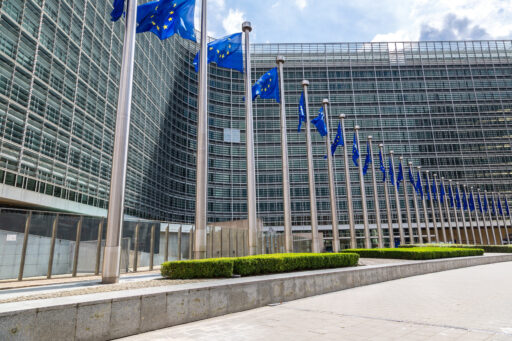
The Council of the European Union, one of the two EU Co-legislators, and representative institution of the Member States, remains in a technical examination phase on the published legislative proposal.
Although a number of discussions have already taken place, including submission of initial written comments by the Member States, our information is that discussions to date have been limited to technical examination of the proposed GDPR simplification measures and no substantive positions have been adopted by the Member States.
The working party responsible for the negotiation, the Antici Group (Simplification), currently meets twice weekly but only discusses the GDPR simplification measure as part of its overall simplification agenda. The last GDPR discussions took place on 19 January, 2026, and the next one is likely to take place before the end of February.
The other co-legislator, the European Parliament, has been focused so far on the AI Act simplification proposal. As of early February, the GDPR proposal is only just entering into a substantive parliamentary work phase, with Committee work finally getting underway in recent weeks.
The responsible joint Committees will be Industry, Research and Energy (ITRA) and Civil Liberties, Justice and Home Affairs (LIBE), who are both currently engaged in the process of appointing rapporteurs.
Representatives of Privacy Next attended the meeting of LIBE on 26 January, 2026, at which the European Commission presented the proposal and answered questions from members of the Committee.
As part of our Next Generation Partnership programme, we will be tracking this very important legislative proposal and providing Partners with more detailed updates, analysis and information on how they can influence the process through collective engagement.
Detailed tracking information will be provided in our exclusive members area which we hope to roll out in Q2 this year.

Square de Meeûs 18
1050 Brussels | Belgium
info@privacynext.eu

Copyrights © 2026 PrivacyNext.eu | Privacy Policy | Cookie Policy Webdesign & Development by ALYS